
Assemblies + backflush
Sell the burger. Draw down the bun.
Sell the finished item and let Tare7 remove the parts or ingredients it used. Each component stays current and can trigger its own reorder warning.
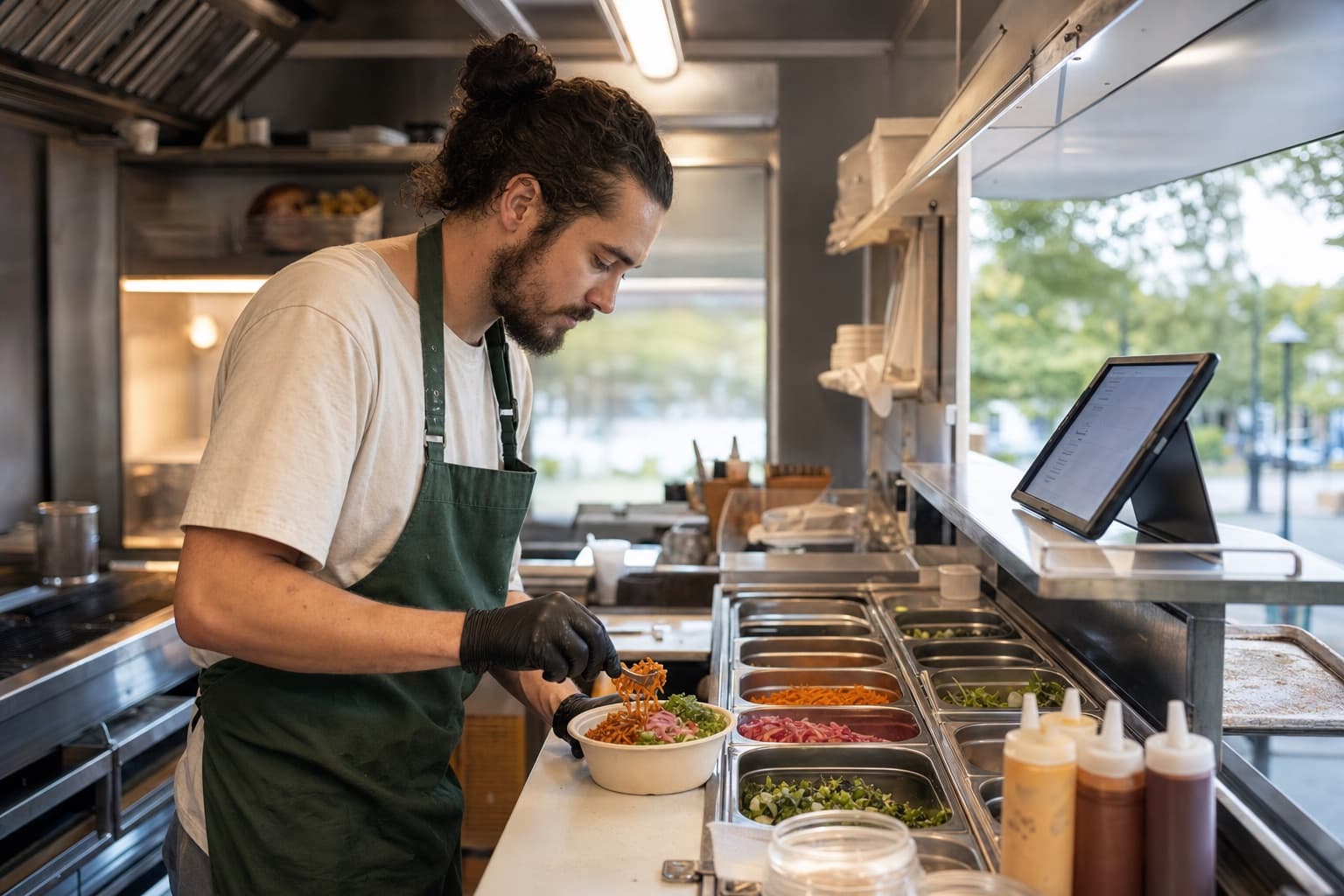
The result
The sale stayed fast while the bun, patties, and lettuce updated in the background from the same tap.
Where this helps
Anyone selling something assembled from stock they buy separately — a food truck, a kitchen, a workshop, a trade doing installs.
What you can stop doing
Counting ingredients on a Sunday night
When you sell finished items but buy ingredients or parts, the shelf never matches the sales report on its own. Tare7 removes the right components with every sale so Sunday night is not spent rebuilding the week from memory.
Why it matters
The component that runs out is rarely the one you were watching. It is the cheap one nobody thought to count.
A worked example
Watch the loose ends disappear, step by step.
A food truck. FT-BURG, the smash burger, sells at $11.00. Its recipe is one brioche bun, two 4oz patties and 30g of shredded lettuce. Bun $0.42, patty $1.16, lettuce $0.006 a gram.
- 1
Define what it is made of
Tell Tare7 that one burger uses a bun, two patties, and 30 grams of lettuce. The burger is what you sell; the ingredients are what leave stock.
- 2
Two burgers go over the counter
One tile, quantity two, $22.00 on the ticket. The person on the window does nothing different.
- 3
Three release rows, not one
Two buns, four patties, and 60 grams of lettuce come off the van automatically. You do not pretend a ready-made burger was sitting in inventory.
- 4
Each component watches its own line
Buns, patties, and lettuce each keep their own quantity and reorder warning. The cheap ingredient that always runs out first finally gets noticed before service.
- 5
The cost is the sum of the parts
$0.42 + (2 × $1.16) + (30 × $0.006) = $2.92 a burger. Two burgers is $5.84 of captured cost against $22.00 of revenue — $16.16 of gross profit, 73.5% margin, from the rows the sale wrote.
- 6
A refund puts the parts back
Refunding replays that sale's own ledger rows, so the bun, the patties and the lettuce return to stock. Not a burger that never existed.
The sale stayed fast while the bun, patties, and lettuce updated in the background from the same tap.
In the app
What you will actually tap, scan, and see.
FT-BURG
Smash burger
Sold × 2 at the counter
- Release−2 ea
Brioche bun
ING-BUN
- Release−4 ea
Beef patty 4oz
ING-PTY
- Release−60 g
Shredded lettuce
ING-LET
Revenue
$1,284.00
COGS
$412.00
Gross profit
$872.00
Margin
67.9%
FT-BURG
Smash burger
$517.12
revenue $704.00 · COGS $186.88 · 73.5% margin
FT-FRY
Fries
$182.90
revenue $279.00 · COGS $96.10 · 65.6% margin
FT-CB
Cold brew
$132.60
revenue $204.00 · COGS $71.40 · 65.0% margin
Cost is stamped on the ledger row when the goods left, so a later price change cannot rewrite last month’s margin. Sale lines with no captured cost are excluded and the report says how much revenue that was.
- RELEASEING-BUN−2 ea
Brioche bun
VAN · FT-BURG backflush · cost captured at 0.42
- RELEASEING-PTY−4 ea
Beef patty 4oz
VAN · FT-BURG backflush · cost captured at 1.16
- RELEASEING-LET−60 g
Shredded lettuce
VAN · FT-BURG backflush · cost captured at 0.006/g
- RECEIVEING-BUN+1 ea
Brioche bun
VAN · Refund · replays the sale row at 0.42
What it means for your day
The same tool solves a different headache in each business.
Food truck / market stall
The obvious case. Sell the burger, draw down the bun — and know at the end of service what you actually consumed rather than what you think you did.
How Tare7 fits this business
Plumber / painter / HVAC
A water-heater install is a recipe too: the heater, the flexi connectors and the solder. Sell the install, consume the parts, and the job's material cost assembles itself.
How Tare7 fits this business
Retail store
Gift sets, hampers and bundles. Sell the bundle at a bundle price while the components come off the shelf individually and reorder individually.
How Tare7 fits this business
Warehouse
Kits shipped as one line but stocked as many. The component roll-up means the kit's availability is a function of its parts rather than a separate number to maintain.
How Tare7 fits this business
Before you rely on it
What this feature does not try to do.
If one of these limits matters to your business, it is better to know before you move the work—not after.
- Recipes are a single level of components. There is no nested bill of materials rolling a sub-assembly up through several tiers.
- Components leave stock when the finished item sells. Tare7 does not manage work in progress, production routes, labor, overhead, or factory scheduling.
- Component quantities are fixed per unit sold. There is no yield percentage, no scrap factor and no substitution rule when a component is out.
- Components come off in their own stocked unit. There is no unit-of-measure conversion, so an ingredient bought by the case and used by the each needs to be stocked in the unit you consume it in.
- Tare7 does not currently block a sale when a component appears unavailable. Reorder points and low-stock alerts warn you about the shortage.
Assemblies + backflush
Sell the finished item once. Let every part underneath it stay current.
Recipes is included from Mobile at $29/month. Change plan whenever you like.